DUI.ms – Powered by Eichelberger Law Firm, PLLC

NEED DUI HELP? CALL US NOW: 601-708-8280

Author: J. Matthew Eichelberger

  • The One Leg Stand test

    The One Leg Stand test

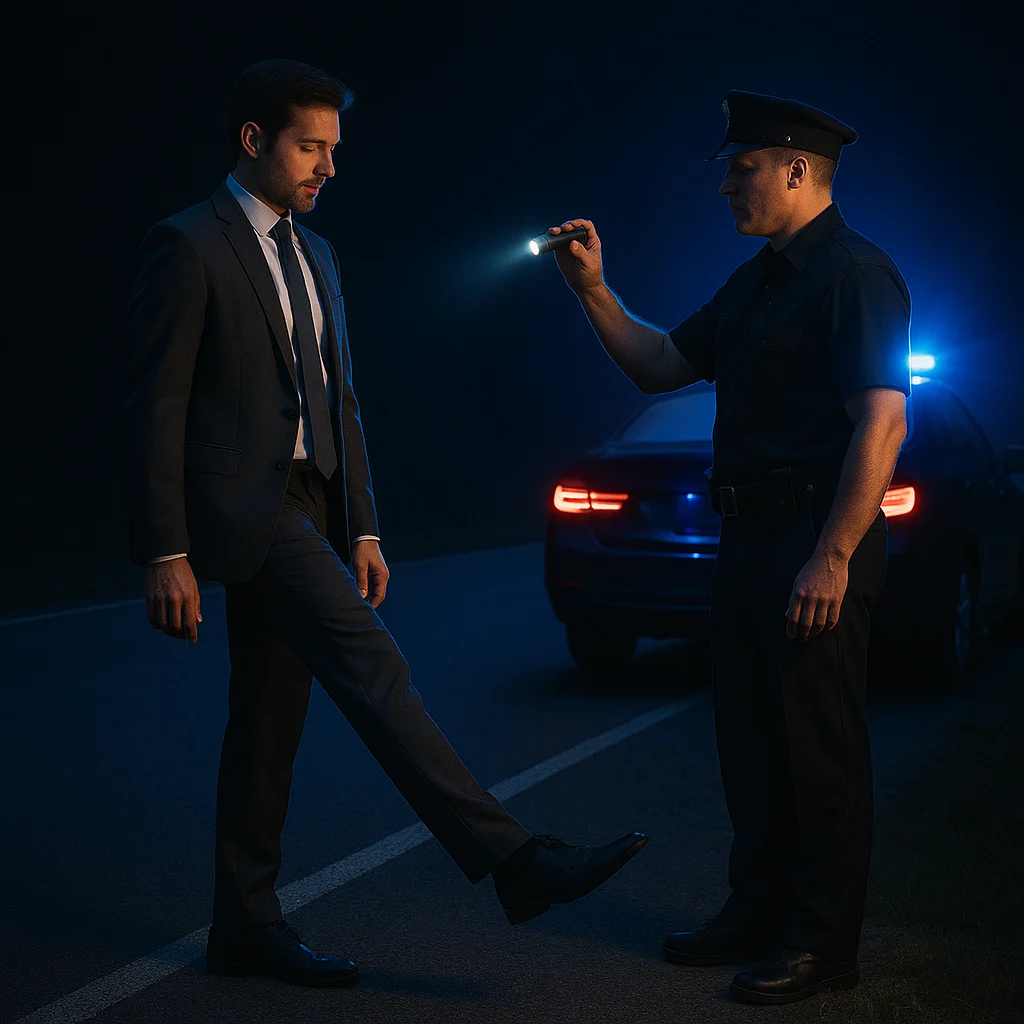
    The final SFST is the One Leg Stand (OLS) test. Like the other two before it, NHTSA has spent time and money over the years testing this test, and has statistics that show it is 83% accurate. As with the others, there are reasons to doubt those statistics that are beyond the scope of this post.

    The One Leg Stand test is what it sounds like. The officer has the driver stand on one leg with their arms at their side and count out loud until told to stop. There is an instruction stage and a “balance and counting” stage. During the instruction stage, the driver has to stand still with their feet together (as opposed to heel-toe like before) with their arms at their side. The officer tells the driver to lift either his left or right foot about 6 inches off the ground with both legs straight and the raised foot parallel to the ground. The driver is then to count out loud “one thousand one, one thousand two, one thousand three” and so on until told to stop. Unbeknownst to the driver, the officer is taught to keep the driver counting to at least “one thousand thirty.” If the officer stops the driver before then, the test is significantly less accurate according to NHTSA.

    There are four clues the officer is taught to look for during the OLS. They are:

    1. Swaying while balancing
    2. Using arms to balance
    3. Hopping
    4. Putting the lifted foot down on the ground

    Here is an example of a more narrative description of the OLS test results in a Mississippi police report for a DUI arrest:

  • Walk this way – The Walk and Turn standardized field sobriety test

    Walk this way – The Walk and Turn standardized field sobriety test

    After the officer conducts the HGN test, they are taught to conduct the Walk and Turn (WAT) test. Like the HGN test, NHTSA has spent a lot of money over the years testing it out in labs and lab-like settings. Also like the HGN test, NHTSA likes to tout statistics to make people believe the test is more accurate than it is. 

    The WAT is a divided attention test, the goal of which is to test a driver’s ability to balance while processing information. The officer is taught to first go over the instructions with the driver, and then have them perform the test. First, they tell the driver to stand still with their feet heel-to-toe and their arms by their sides as they listen to the instructions. This is not a normal way of standing, of course. The officer then gives the driver the rest of the instructions, and demonstrates it for the driver. This part not only tests the driver’s balance, but also his ability to process and remember the instructions. Here are the instructions, which vary slightly from officer to officer:

    “You are to take nine heel‐to‐toe steps in a straight line. After the ninth step, you are to turn in the prescribed manner which I will show you in a moment, then take nine heel‐to‐toe steps back down the line. You are to count the steps out loud, and watch your feet the whole time. During the turn, you keep your front foot on the line, and using your other foot to take several small steps to complete the turn. Now I will show you what I am asking you to do.” 

    NHTSA teaches officers to observe the driver’s behavior during this “instruction stage” of the WAT. After the instruction stage, the walking stage begins. During the walking stage, the driver’s attention is divided between walking heel‐to‐toe and turning, counting the steps out loud, and remembering the number of steps and how to do the turn properly. It’s…a lot.

    Officers are taught to look for the eight following clues on the WAT:

    1. Can’t keep balance while listening to the instructions
    2. Starts too soon
    3. Stops while walking
    4. Doesn’t touch heel-to-toe
    5. Steps off the line
    6. Uses arms for balance
    7. Makes an improper turn
    8. Incorrect number of steps

    Sometimes the officer gives the results of the WAT in a more narrative format in their reports, but usually it looks like this:

    WAT notes

    As you can probably guess, a lot can affect a person’s balance aside from being intoxicated. Footwear, inner ear issues, the road surface itself, and oncoming vehicles are just a few of the variables that can come into play with this test. The instruction stage can also last a very long time, which can affect a person’s ability to stand still. Weather (wind, cold, rain, etc.) can also play a factor as well.

    Next, let’s look at the One Leg Stand sobriety test.

  • The Horizontal Gaze Nystagmus Test, or “I could see it in his eyes”

    The Horizontal Gaze Nystagmus Test, or “I could see it in his eyes”

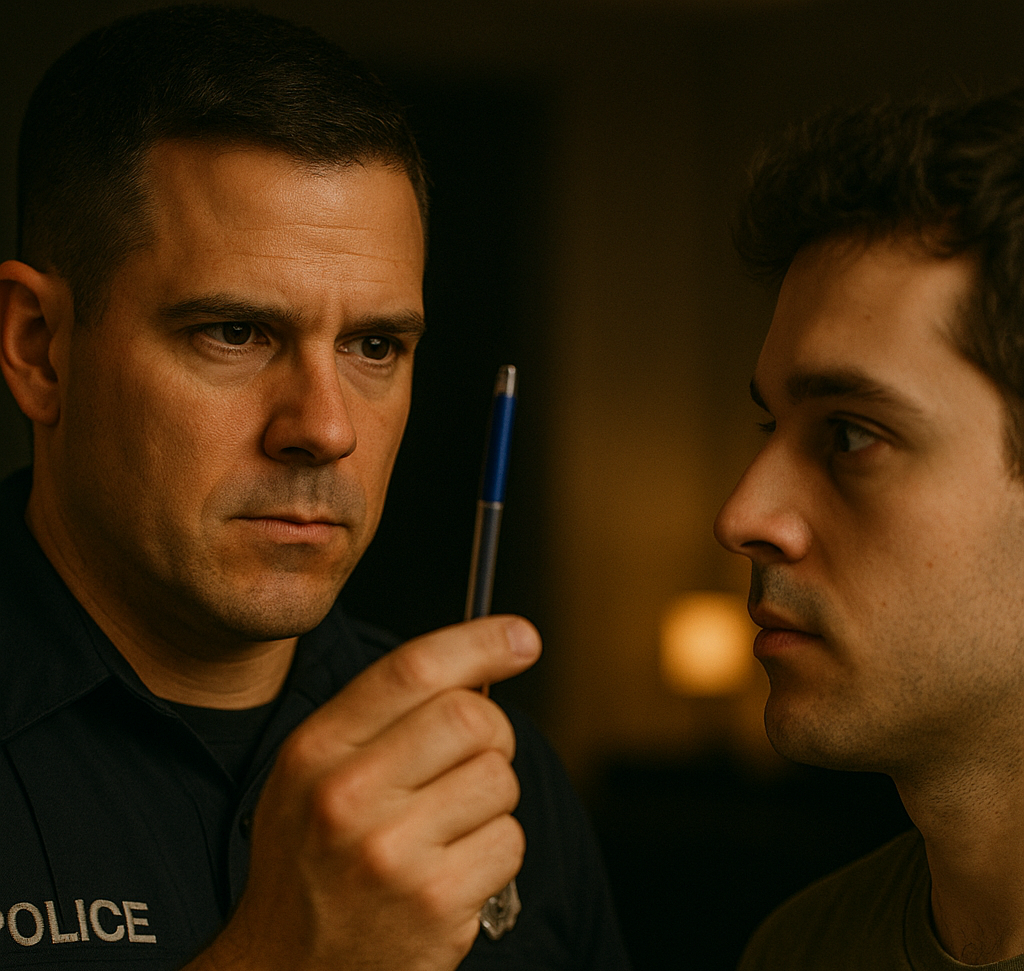
    The first of the tests is the horizontal gaze nystagmus test, or HGN. The idea behind this test is that the presence of alcohol or certain drugs in a person’s body impacts fine muscle movements, and the eyes are the best place to observe that. The officer starts by having the driver stand still with their eyes watching a small “stimulus”, like the tip of a pen, a pencil eraser, or a penlight. Since it’s usually dark outside when officers are conducting this test, a penlight is probably the most commonly used. 

    The officer then tells the driver to follow the stimulus with their eyes only, and to not move their head. They’ll say “follow it as far as you can without moving your head,” or something similar. The officer is taught to look for bumpy, “jerking” movement in the eyes. This is called horizontal gaze nystagmus, and it can be caused by many things, including high blood pressure, nicotine, antihistamines, and the flu. It can also be caused by the presence of alcohol in the body.

    As with the other SFSTs, there are a list of “clues” that the officers are looking for. They are to examine each eye for three clues, always starting with the left eye. The maximum number of clues for each eye is three, so the maximum number of clues on the HGN test is six. The three clues are:

    1. Lack of smooth pursuit – the driver’s eye jumps from point to point instead of smoothly following the pen all the way to the side
    2. Distinct and sustained nystagmus at maximum deviation – when the driver’s eye has gone as far as it can to the side, the eye twitches
    3. Onset of nystagmus prior to 45 degrees – the driver’s eye begins to jerk before reaching a 45-degree angle

    There are plenty of reasons to doubt the accuracy of these “clues,” but that’s what the NHTSA teaches the officers to look for. Typically, an officer’s report will read something like this: 

    Notice how the officer went in order from 1 through 3 with each clue and reported a total of six out of six clues. Also notice how the officer mentions vertical nystagmus. Vertical nystagmus doesn’t have the same history of testing that horizontal nystagmus does, but that doesn’t stop the NHTSA from mentioning it in their training programs or officers from talking about it in their reports.

    Next, let’s look at the Walk and Turn, or WAT.

  • Standardized Field Sobriety Tests, or “Pre-Arrest Screening”

    The next phase of DUI investigation is something the National Highway Traffic Safety Administration (NHTSA) calls “Pre-Arrest Screening,” which seems by its name to imply that the decision to arrest has been made. “Pre-Arrest Screening” sounds like something an officer does to make sure the person being arrested doesn’t have any medical issues, and not to make sure the arrest should happen in the first place. But I digress.

    The first step in the “Pre-Arrest Screening” phase is putting the driver through Standardized Field Sobriety Tests (SFSTs), or what a lot of us (law enforcement and lawyers) call “Stupid Human Tricks” after the Dave Letterman bit. The NHTSA’s spent a lot of money developing these tests over the years, and they are quick to tout the “success rate” of these tests in identifying impaired drivers. The problem is that these tests were developed in lab or lab-like settings, with sober test subjects (.00-.05% BAC) or very intoxicated ones (.15% or higher BAC). That’s not to say that they don’t have some validity, but crowing about a test’s ability to identify people with a BAC twice the legal limit strains credulity just a bit, doesn’t it? 

    The three Standardized Field Sobriety Tests are the Horizontal Gaze Nystagmus test (HGN), the Walk-and-Turn test (WAT), and the One Leg Stand test (OLS).

  • “Please step out of the vehicle, sir.”

    Now that the police officer has made a decision to ask the driver to step out of the vehicle, the officer begins to pay more attention to the driver’s physical abilities. First, the officer is taught to watch what the NHTSA calls “the exit sequence,” or what normal human beings call “getting out of the car.”

    Officers are taught to look for drivers who become angry when asked to step out, can’t follow instructions, leave the car in gear, can’t open the door, lean against the car, or can’t keep their balance without holding onto the car. And if they see any of those things, they add it to their list of reasons why they think the driver is impaired and should note that in their written report.

    So by all means, if you find yourself in a situation where an officer is asking you to step out of the car, please pay attention to what you are doing.

    The next thing that happens is covered in Step 3 – The Tests.

  • Personal Contact – Meeting the law enforcement officer who is trying to decide if they should charge you with a crime

    Officers are taught to “approach, observe, and interview” the driver while the driver is still behind the wheel. They know to look for any signs of impairment, and are taught to use their senses of sight, hearing, and smell to do so. Here is a breakdown of what they are taught to be aware of:

    • What they see
      • Bloodshot eyes
      • Soiled clothes
      • Fumbling fingers
      • Alcohol containers
      • Drugs and drug paraphernalia
      • Bruises, bumps, and scratches
      • Other unusual behavior
    • What they hear
      • Slurred speech
      • Admission of drinking
      • Inconsistent responses
      • Unusual or nonsensical statements
      • Abusive or foul language
    • What they smell
      • Odor of intoxicating beverage
      • Marijuana
      • Heavy use of “cover up” odors like Febreze or other deodorizers

    A collection of some of these (and believe it or not sometimes ALL of these) clues will wind up in the officer’s report if he decides to charge a person with DUI. In fact, experienced DUI lawyers will tell you that the phrases “I smelled the odor of an intoxicating beverage” and “the subject had glassy, bloodshot eyes and slurred speech” appear so frequently near the beginning of DUI officer reports that they appear to be copied and pasted from report to report across Mississippi. 

    The officers are also taught to question the driver extensively and to use a technique called “divided attention” questioning. Divided attention questioning usually begins with the officer asking the driver to produce two things: their drivers license and their insurance card. This makes the driver remember two simple tasks, to retrieve both items and hand them to the officer. If the driver has difficulty remembering to give him both items, the officer is taught that this may mean they are impaired. 

    The officer is then to ask the driver questions while he is fishing for his license and insurance card. This is the core of the divided attention questioning technique: it makes the driver think about multiple things at the same time. The inability to do that is a pretty good indicator that the driver is impaired by alcohol or some other substance, at least according to the NHTSA. The officer will ask questions like “where are you coming from?” or “where are you headed?” while closely watching not just what the driver says (nonsensical answers) but also how the driver says it (slurred speech). The officer may also ask unusual questions, like “what is your middle name?” to further test the ability of the driver to answer.

    At this point, the officer is taught he should be on the lookout for any potential medical issues that might mimic drug or alcohol impairment. They are taught they should ask the driver if they have any physical disabilities, are under the care of a doctor, are diabetic or epileptic, or are on any medications. If they don’t ask these things that doesn’t mean they can’t go forward with the DUI investigation. It just may hurt them later at trial if a medical condition is actually a factor.

    The officers may decide at that point that the driver isn’t likely impaired and release them, or they may ask the driver to exit the vehicle for further testing. But before the testing starts, the officer is looking for even more clues as you step out of the vehicle. Read about that here.

  • Big Brother’s watching – What law enforcement officers are looking for when they are watching you drive

    When an officer is on patrol, he may have as part of his assignment to be on the lookout for drunk or otherwise impaired drivers. Normally, officers who are given this task have been specially trained in DUI enforcement through the Mississippi Law Enforcement Officers Training Academy (MLEOTA) in Pearl. If they were not trained at MLEOTA, they typically received DUI enforcement training somewhere. And almost always, the training any officer receives is based upon standardized DUI educational materials authored by the National Highway Traffic Safety Administration (NHTSA), which is part of the United States Department of Transportation.

    The standard DUI training from NHTSA covers everything from an officer’s first view of a car in motion through arrest and reporting. The first part NHTSA covers is “vehicle in motion” observation. 


    Vehicle in Motion

    When an officer sees a car moving down the roadway, he is taught to look for clues that its driver might be impaired. There are four categories of clues that officers are taught to look for to detect potential driver impairment, along with examples the officers are given:

    • Problems in maintaining proper lane position
      • Weaving
      • Crossing lane lines
      • Drifting
      • Straddling a lane line
      • Swerving
      • Nearly running into another vehicle or object
      • Turning with a wide radius
    • Speed and braking problems
      • Stopping too short or too far
      • Braking in a “jerking” fashion
      • Unnecessary speeding up or slowing down
      • Varying speed
      • Driving 10mph or more under the speed limit
    • Vigilance problems
      • Not turning headlights on at night
      • Failing to use turn signal or using it incorrectly
      • Driving in the wrong lane (against traffic)
      • Stopping for no apparent reason
    • Judgment problems
      • Following too closely
      • Improper lane change
      • Illegal turn
      • Driving off of the road

    Officers are taught that some of these clues are more indicative of DUI than others, but that the presence of any single one of them means there is a 35% chance the driver is impaired. For example, NHTSA says that weaving across lane lines means there is a 50% chance the driver is impaired, while swerving (an abrupt jerking of the car into another direction of travel to correct drifting) means there is a 70% likelihood of impairment. When any two clues are combined, the officers are taught that there is at worst a 50% chance that the driver is impaired.

    Officers only need probable cause (generally defined as more likely than not, or more than 50% likely) to  believe a driver is impaired to initiate a traffic stop. So if they see a vehicle swerve, or if they see a driver follow too closely and then change lanes without using a signal, they will feel confident that they can stop the driver under suspicion of DUI.

    If the officer decides to stop the car, he or she then watches the way in which the driver stops the car for more clues of impairment. They are taught to watch for the following:

    • Trying to flee
    • No response to the blue lights or a slow response
    • Abruptly weaving
    • Sudden stop
    • Hitting the curb while stopping
    • Any new traffic violation

    This first phase, Vehicle in Motion, is an important evidence gathering phase for the officer, who is building his DUI case from that very moment. If you wind up charged with DUI, you can expect to see some of the above referenced in the officer’s report. The next phase is when the officer first interacts with the driver, which you can learn more about in Step 2 – First Contact with Law Enforcement.

  • Explaining Mississippi’s DUI statute

    Drivers have basic legal obligations concerning sobriety on Mississippi roadways. Section 63-11-30 of the Mississippi Code is the statute that governs operating a motor vehicle while under the influence of alcohol or other substance. The first subsection of 63-11-30 lays out exactly what a person can’t do, and we’ll spend time on that in this post.

    The first subsection of 63-11-30 reads:

    (1) It is unlawful for a person to drive or otherwise operate a vehicle within this state if the person:

    (a) Is under the influence of intoxicating liquor;

    (b) Is under the influence of any other substance that has impaired the person’s ability to operate a motor vehicle;

    (c) Is under the influence of any drug or controlled substance, the possession of which is unlawful under the Mississippi Controlled Substances Law; or

    (d) Has an alcohol concentration in the person’s blood, based upon grams of alcohol per one hundred (100) milliliters of blood, or grams of alcohol per two hundred ten (210) liters of breath, as shown by a chemical analysis of the person’s breath, blood or urine administered as authorized by this chapter, of:

    (i) Eight one-hundredths percent (.08%) or more for a person who is above the legal age to purchase alcoholic beverages under state law;

    (ii) Two one-hundredths percent (.02%) or more for a person who is below the legal age to purchase alcoholic beverages under state law; or

    (iii) Four one-hundredths percent (.04%) or more for a person operating a commercial motor vehicle.

    So basically you can’t be drunk or high while driving, or you are in violation of this statute. (1)(a) and (1)(d) deal with alcohol, while (1)(b) and (1)(c) cover being impaired by a substance other than alcohol. Of course someone may be in violation of a statute, but later be found not guilty in court or have their charges dismissed. How that happens is a whole other ball of wax.

    More and more, we are starting to see DUI charges issued under (1)(b) and (1)(c). If a person is accused of driving while high on marijuana, he will be charged under (1)(b) and/or (1)(c). Same for cocaine, codeine cough syrup, etc. But still the most frequent types of DUI charges in Mississippi are alcohol-related, and fall under (1)(a) and (1)(d). DUI charges under (1)(a) are usually called “common law DUIs” to distinguish them from (1)(d) charges, which are supported by a blood alcohol content reading from a machine that analyzes a DUI suspect’s breath for alcohol content.

    What is the purpose of common law DUI? Common law DUIs existed back before the technology was developed to somewhat accurately measure the amount of alcohol in a person’s bloodstream. They are still around because people can refuse to give a breath sample or may be physically unable to provide one, and because sometimes the testing machines are not available. In those instances, there is no machine reading for purposes of subsection (1)(d).

    You’ll notice that the subparts of (1)(d) have different BAC levels for different types of drivers: regular adult drivers, drivers who are minors, and people who are driving commercial vehicles (think 18 wheelers and busses). That’s because minors aren’t supposed to be drinking at all, and because commercial vehicle drivers are behind the wheel of large vehicles that can do a lot of damage very quickly.

    So that is the 10,000-foot view of the main portion of Mississippi’s most important DUI statute. In the next part, we’ll go into what DUI enforcement officers are taught about identifying potentially impaired drivers both before stopping the car and before asking the driver to exit the vehicle.

    And remember, if you need help right away, contact the Eichelberger Law Firm as soon as possible.

  • A hidden DUI-related license suspension you may not know about

    When people think about DUIs, they think about jail time, losing their jobs, and license suspensions. What they often don’t think about is that there can be more than one type of license suspension depending on the type of DUI charge (refusal, BAC over .08, or DUI drug/other substance). And they certainly don’t think about the fact that those suspensions can run consecutive to each other.

    The one people (including some lawyers, so beware) don’t think about is the license suspension that comes automatically when a person charged with DUI doesn’t request a trial date within 30 days of receiving the DUI charge.

    Importantly, this applies if the person charged with DUI gave a breath sample (blew on the Intoxilyzer) that exceeded the .08 legal limit. If that’s the case, the driver has to file a request for extension of driving privileges if their trial is not being held within 30 days of the DUI charge. If they do not request this extension, their license will be suspended for a period of 90 days, and this is in addition to any other licenses suspension they may get for being convicted of the DUI or entering into a nonadjudication program. 

    So if you have been charged with a DUI for blowing over .08, it is important that you quickly hire a lawyer to communicate with the court and extend your driving privileges. We have decades of experience in successfully navigating our clients through DUI charges in Mississippi courts, so if you or a loved one have been charged with driving under the influence, do not hesitate to reach out to us immediately

  • VIDEO: What should you do if you are arrested in Mississippi?

    What should you do if you’re arrested in Mississippi?

    In this video, criminal defense lawyer Matt Eichelberger explains your rights, including what to say (and what NOT to say) when dealing with law enforcement. Getting arrested can be overwhelming, but knowing your rights can help protect you from making mistakes that could hurt your case.

    In this video, we cover:

    🔹 What to say when you’re arrested

    🔹 How to handle police questioning

    🔹 Why you should NEVER consent to a search

    🔹 What happens during the booking process

    🔹 How bail works in Mississippi

    If you or someone you love has been arrested in Mississippi, contact Eichelberger Law Firm for a consultation. We’ve helped thousands of clients navigate the criminal justice system and fight for their rights.